How much solar is allowed in WA? - Updated April 2026
From May 2026 the following rule changes come into effect...
This Western Power table is explained below
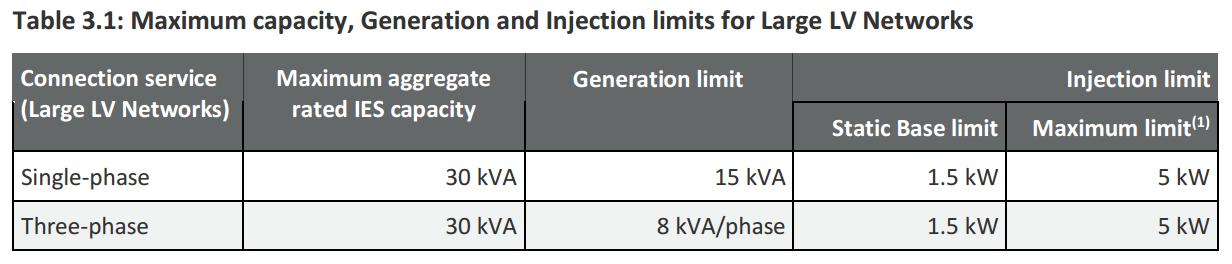
The short version about these new rule changes.
If you have single phase power to your house you can now install up to 15kW of solar and battery inverters.
Less than 12 months ago the limit was just 5kW so it is a huge change in direction by Western Power.
(But, of course, they have their own vested interests and newly imposed conditions for this apparent 'generosity')
If you have three phase, you can now install a 20kW solar and battery inverter, up from 15kW.
You can even install a 25kW or 30kW inverter if you want, but it has to be restricted to no more than 24kW AC output.
Your old inverter is now useless and will most likely going to Africa for a new life.
You may have to replace your entire switchboard especially ones with old ceramic fuses and switches (no longer fit or safe for purpose).
At setup, Synergy require total remote control of your solar and battery system...
and sometimes even your EV charger if you can use Vehicle to House/Grid technology.
Not a new rule but one worth bearing in mind...
Single phase main switch limited to 63A (approx 15kW total)
Three phase main switch limited to 32A per phase (approx 22kW total)
Whatever power passes across the main switch (and Western Power's service fuse) is constrained by these limits.
If any of the above raises questions then read on...
30kVA Maximum IES Capacity
IES means "Inverter Energy Supply"
A 10kVA solar inverter is the same as a 10kW solar inverter so lets stick with kW.
You can have 30kW of inverters connected to either single or three phase house switchboards.
However, an 'inverter' can be many things...
It could be running solar panels only...therefore a solar inverter.
It could be running a battery only...therefore a battery inverter.
It could combine both of the above tasks..therefore a 'multi mode' or 'hybrid' inverter.
It could be an electric vehicle if running 'vehicle to home' capability.
It could be a wind turbine, fuel cell or even a water turbine, but we are departing from practical reality.
A petrol/diesel generator would NOT be an IES
15kVA Generation limit for single phase homes.
Whilst you can have 30kVA inverter capacity you can only use a maximum of 15kW for house loads.
On the face of it this makes no sense but there is method to the madness...for a very small number of people.
Lets say you have a HUGE home storage battery and two or three EVs that need charging during the day.
You have an enormous roof which you want to fill with solar panels.
You install 3 x Sigenergy 10kW single phase inverters with batteries connected to all of them.
You have 60kW of panels on the roof.
Your 30kW of inverters are crippled to 15kW of AC output for loads in the house, but that's not a problem for you.
What you want is DC power from the panels to flow directly, unconverted to AC, into your EV and batteries.
That's possible with Sigenergy's DC EV charger and batteries.
Forgetting EVs it is possible with other brands than Sigenergy as well for BIG battery charging.
Like I say, very niche.
8kVA per phase Generation limit for three phase homes.
A 15kW three phase solar/battery inverter supplies 5kW per phase.
A 20kW inverter supplies 6.66kW per phase.
A 25kW inverter supplies 8.33kW per phase.
A 30kW inverter supplies 10kW per phase.
Therefore for MOST '3 phase' homes the new rules provide one additional benefit...
You can now install 20kW 3 phase inverters which might also give you an extra 'MPPT'
For others needing more DC power (see single phase explainer above) can now install a
20kW or 30kW 3 phase inverter and generation limit it to 8kW per phase.
But...
From May 1st installers are required to...
...use Synergy Functionality Requirements and Interconnection Handbook.
This includes commissioning systems using the CSIP-AUS standard
This means we have to commission every install using the dreaded Synergy 'Installer Test Kit'.
We finish an install and then connect to Synergy's computers who run a test to make sure they have 'control'.
This gives Synergy complete control of your entire system should they ever need to shut it down.
Of course they will never ever do this, pinky promise, unless you are installing small 5kW inverters.
As a reward for leaving the door unlocked for them to come and go as they please, you get more unpaid export capability.
Static Base limit for exports 1.5kW
Whilst we have to commission a new >5kW inverter making sure you are online and connected to Synergy's computers,
it doesn't mean YOU have to stay that way.
If you decide you don't want them having access, so change your WiFi password etc then you are free to do so.
We have to set your system up so that when it loses connection to Synergy your exports are limited to 1.5kW.
Maximum export limit 5kW
If you stay connected to Synergy you can export up to 5kW of your surplus solar power.
This seems a bit daft seeing as you get paid nothing at all for exports anyway but perhaps that rule will change.
Note that I am talking only about inverters greater than 5kW.
If you have a 5kW inverter you get paid the princely sum of 2 cents per kWh for exports under the DEBs scheme.
Your existing inverter is going on a working holiday to Africa.
One of the new rules is that ALL inverters must work together to achieve the above limits, and provide Synergy control.
In theory that means you can leave your beloved Fronius/SMA inverter in place to run the panels and add a new battery inverter.
All you need is for the new inverter to be able to control the production of your old inverter.
Or you could install a third party 'gateway' that both new and old inverters connect to and the output of both is controlled by the 'gateway'.
Remember that Synergy require total 'control' at the point of commissioning any change to your existing setup.
If that cannot be 'proven to work' on install date then the whole thing has to be taken down and start again.
Finding an installer prepared to install and later warranty that solution is going to be VERY difficult.
We certainly wouldn't do it. You get a new hybrid inverter and your old one goes to Africa for a new life.
(Or you can keep it as an anchor for your boat).
and...your switchboard may need to be replaced.
If your switchboard is an old one with fuses and ceramic switches, it likely has to be replaced.
Even a more modern switchboard with a hodge podge of old breakers and type AC RCDs may have to go.
Those boards are simply not capable of safely carrying the current these new inverters limit can deliver.
For many years a full switchboard replacement cost about $1,500 but it's typically $2,500 now, sometimes more.
Components are more expensive, but mostly it is the cost of labour that's has pushed prices up.
Western Power in their briefing to industry for these May 2026 changes were VERY clear on this matter.
Switchboards will be a key area of inspection focus going forward.
Electricians will have mixed feelings about this.
A new switchboard, at $2,500 earns them a decent profit but also takes a lot of time.
Time is in very short supply especially for solar and battery electricians.
I can see a bit of a bonanza coming for 'regular' sparkies as the demand for switchboard replacements explodes.
A one man band sparkie who just does switchboards and EV chargers is going to have a pretty comfortable life.
If you are such a person, please get in touch with me as we will have a lot of referrals for you.
Final takeaways.
The new rules are all about giving Synergy and Western Power more control of people's inverters.
For three phase homes the larger limits ARE a benefit.
For single phase homes a 15kW generation limit is also excellent except...
I don't know of any single phase inverters that are larger than 12kW, but I guess you could join a 10 and 5 together.
Your old inverter that faithfully ran your solar panels for years...is gone.
The one thing that is abundantly clear about these changes is that consumer (and installer) choice has been substantially diluted.
Western Power and Synergy clearly failed to get what they wanted via the unpopular 'WA battery rebate' rules.
So now they have just thrown in those changes as a requirement anyway whether you take the rebate or not.
From our perspective as a retailer/installer who refused to offer the WA rebate, we may now end up reversing our position.
The 'control' we disliked about the rebate conditions is now mandatory.
Which all goes to prove yet again that you can't fight city hall.
Western Power and Synergy are 100% owned by the WA government which is both a good and bad thing of course.
(Good in that we would be likely paying a lot more for electricity if it weren't for Government price controls.)
or email
This review was written by Andrew MacKeith, Solar4Ever service manager since 2011.